Guidelines for submitting articles to La Torre Golf Resort Today
Hello, and thank you for choosing La Torre Today.com to publicise your organisation’s info or event.
La Torre Golf Resort Today is a website set up by Murcia Today specifically for residents of the urbanisation in Southwest Murcia, providing news and information on what’s happening in the local area, which is the largest English-speaking expat area in the Region of Murcia.
When submitting text to be included on La Torre Golf Resort Today, please abide by the following guidelines so we can upload your article as swiftly as possible:
Send an email to editor@spaintodayonline.com or contact@murciatoday.com
Attach the information in a Word Document or Google Doc
Include all relevant points, including:
Who is the organisation running the event?
Where is it happening?
When?
How much does it cost?
Is it necessary to book beforehand, or can people just show up on the day?
…but try not to exceed 300 words
Also attach a photo to illustrate your article, no more than 100kb
PROPERTY SEARCH
PROPERTY SEARCH
article_detail
Date Published: 24/08/2026
Spain's next big show is coming with a partial lunar eclipse on August 28
The Moon will be almost completely swallowed by Earth’s shadow during the early hours of Friday, with the best views in western Spain
A spectacular partial lunar eclipse is set to give people across Spain an early-morning sky show on Friday August 28, just over two weeks after the country was at the centre of attention for the total solar eclipse on August 12.
The August 28 eclipse won’t be total, but it will come remarkably close. At its peak, around 93% of the Moon’s diameter will be inside the darkest part of Earth’s shadow, known as the umbra. Around 96% of the visible lunar surface will be covered by the shadow.
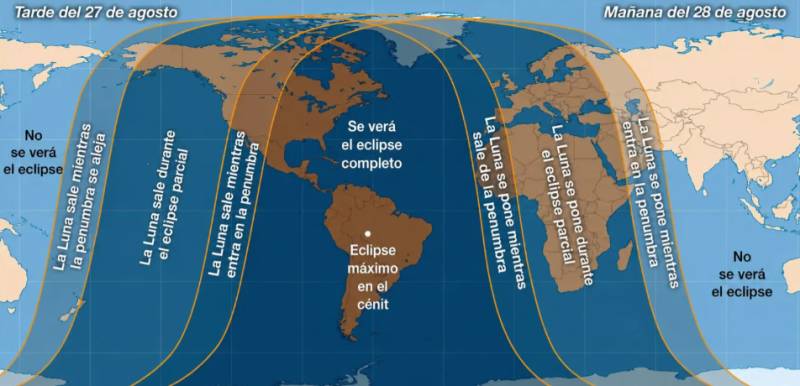
The event will be visible across Spain, although exactly how much of it you’ll see will depend on where you are. The Moon will be heading towards the western horizon during the eclipse, meaning people in western Spain will have the best chance of seeing the partial phase right through to the end.
For those in eastern parts of the country, including the Region of Murcia and Alicante, the Moon will set before the eclipse has finished. Even so, the most dramatic part of the event will take place while it’s still above the horizon.
What time will the lunar eclipse be visible in Spain?
The eclipse will begin during the early hours of Friday August 28, although there’s little reason to set an alarm for the very beginning.
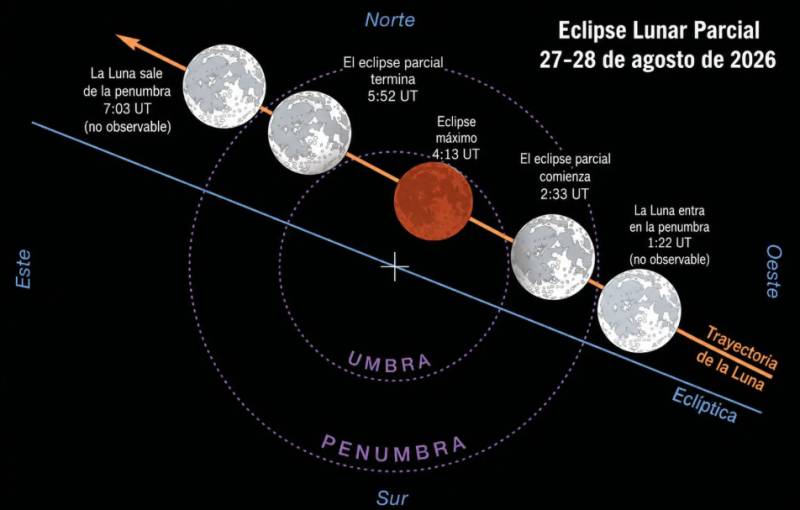
The first stage starts at around 3:23am Spanish time, when the Moon enters the outer part of Earth’s shadow. This is known as the penumbral phase and the change will be difficult to spot with the naked eye.
Things get much more interesting from around 4:33am, when the Moon begins moving into the darker umbra and the partial eclipse officially gets underway.
The eclipse will reach its maximum at approximately 6:13am, when almost the entire Moon will be sitting inside Earth’s shadow.
The partial phase will then continue until around 7:52am, followed by the final, much fainter penumbral stage.
The exact view will vary across Spain because sunrise and moonset times differ from one location to another. In the west of the country, as well as in the Canary Islands and Ceuta, observers will have the opportunity to watch the partial phase until it ends. In many parts of central and eastern Spain, the Balearic Islands and Melilla, the Moon will set before then.
What will the eclipse look like?
Although this isn’t a total lunar eclipse, it should be an impressive sight because such a large proportion of the Moon will be covered by Earth’s shadow.
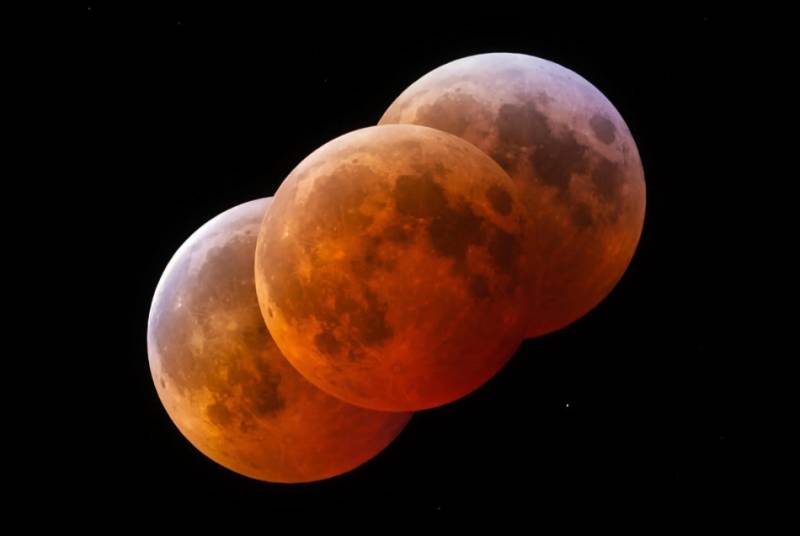
Rather than the entire Moon disappearing, a small section will remain illuminated while the rest becomes noticeably darker. The eclipsed part could also take on orange, copper or reddish tones as sunlight passes through Earth’s atmosphere before reaching the Moon.
That effect is caused by the atmosphere filtering sunlight. Blue light is scattered more easily, allowing more red and orange light to pass through and reach the lunar surface.
So while it’s technically a partial lunar eclipse, don’t be surprised if the Moon takes on some of the colours normally associated with a so-called blood moon.
The exact colour will depend on atmospheric conditions around Earth at the time.
Where is the best place to watch it in Spain?
For Spanish observers, location will make a difference because the eclipse takes place as the Moon is getting lower in the sky.
Generally, the further west you are, the better your view will be. People in western mainland Spain should be able to see more of the eclipse than those on the eastern coast.
For anyone in Alicante or the Region of Murcia, the timing still makes it worth getting up early. The Moon will remain visible during the most dramatic part of the eclipse, including the maximum, although it will be relatively low in the western sky.
Finding somewhere with a clear view towards the west will therefore be important, particularly in areas where buildings, hills or other obstacles could block the Moon.
Do you need special equipment?
The good news is that lunar eclipses are much easier to watch than solar eclipses.
There’s no need for special eye protection and it’s perfectly safe to look directly at the Moon throughout the event.
You don’t need a telescope either. The eclipse should be clearly visible with the naked eye as long as skies are clear and you have a good view of the western horizon.
Binoculars can give you a closer look at the changing shadow, while anyone with a camera and a suitable zoom lens could have a go at photographing the event.
The low position of the Moon in the Spanish sky could also make for some interesting photographs, particularly if you can frame it alongside a building, landscape or other landmark.
A second eclipse for Spain in August
The lunar eclipse comes just 16 days after the total solar eclipse on August 12, making August 2026 an unusually exciting month for anyone interested in astronomy.
The two events are also very different. During a solar eclipse, the Moon moves between Earth and the Sun, blocking some or all of the Sun from view. During a lunar eclipse, Earth moves between the Sun and Moon, casting its shadow across the lunar surface.
For people in Spain, that means there’s another chance to look up at the night sky just weeks after the spectacular solar eclipse that attracted huge attention across the country.
While the August 28 event won’t have the same dramatic moment of totality, its unusually deep partial phase means it should still be well worth setting the alarm for.
Images: CTIO/NOIRLab/NSF/AURA/P. Horálek (Institute of Physics in Opava) / NASA