














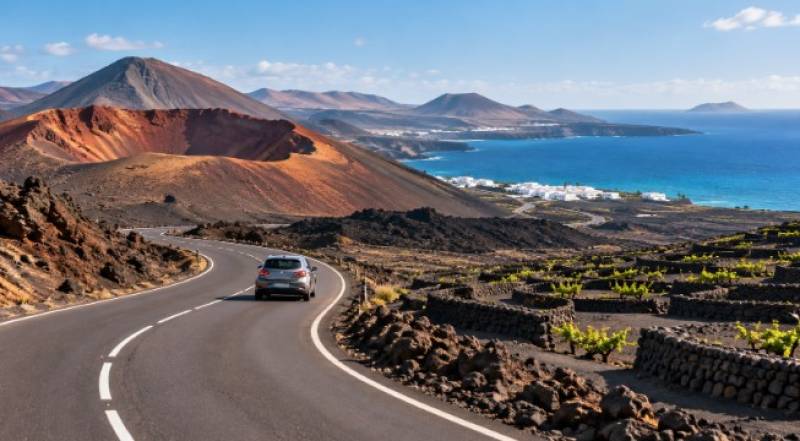
 Lanzarote doesn't reward rushing. Buses run on their own logic – one that rarely lines up with a traveler's plans – and taxis quietly drain the budget the moment you start crossing the island from one end to the other. A car flips that whole equation. Timanfaya at sunrise. A stop in La Geria's black vineyards around lunch. Famara's cliffs before the light goes soft in the afternoon. No waiting around, no fixed stops – just the island on its own terms.
Here's the thing about the map, though: it lies a little. Lanzarote looks compact, almost walkable, but its landmarks sit in completely different worlds – arid craters in the south, cave systems up north, quiet fishing towns tucked along the east coast. Buses cover the resorts fine. Everything that actually makes the island interesting? That's the part they miss.
Arrecife and Playa Blanca are where most people land, and either works as a solid launch point for a loop around the island. Sorting out alquiler coche Lanzarote before touching down means skipping the airport-counter scramble – which, in peak season, can genuinely eat an hour of a trip. From there the island breaks into three rough zones worth thinking about separately: the volcanic south, the Manrique-heavy center around Teguise, and a windier, wilder north.
A handful of things worth knowing before setting off:
* Fuel stations thin out fast once you leave Arrecife – top up before the tank drops below half.
* The roads cutting through Timanfaya's protected zones are narrow, shared with cyclists, and not the place to rush.
* Parking in Playa Blanca or Puerto del Carmen gets tight by mid-morning, summer especially.
* Distances look short on paper. Coastal bends make the drive longer than it should be – budget extra time.
Timanfaya National Park is the obvious anchor for any itinerary here, and it earns that spot. The terrain barely looks like Spain at all – cracked lava fields, steam still rising from vents, craters carved by eruptions that reshaped roughly a third of the island back in the 1730s. Private cars stop at the entrance; the park itself is seen by official coach tour from there. Still, driving yourself in beats waiting on an organized transfer from somewhere else.
Past Timanfaya, the road drops into La Geria, where vines grow one at a time in individual volcanic pits, each shielded by a curved stone wall built specifically to trap what little moisture the soil gets. A few small bodegas along this stretch pour tastings, and stopping at one – maybe two – makes for a natural pause before continuing south toward the coast near Playa Blanca. Black soil giving way to rows of healthy vines. It shouldn't work, and somehow it does.
The north is a different story entirely. Jameos del Agua – carved out of a collapsed lava tube by artist and architect César Manrique – folds natural cave formations into restaurant terraces and a concert space, one more sign that Manrique's touch is on nearly every major site across the island. Cueva de los Verdes, close by, runs deeper into that same volcanic tunnel network, open now for guided walks through chambers formed thousands of years ago.
Further along sits the Mirador del Río, perched above the Chinijo Archipelago with views across to La Graciosa that are tough to beat anywhere else on Lanzarote. Manrique's building again – tucked so quietly into the cliffside it's barely visible until the road is already there. Arrive mid-morning, before the tour buses fill the small car park, and the strait is usually still quiet enough to actually enjoy.
Inland, the old capital of Teguise breaks up the drive between north and south nicely. Cobbled streets, a colonial-era church, centuries of history that predate the island's tourism entirely – and a Sunday market well known enough to pull in locals alongside visitors. Even without the market running, Teguise's plazas offer something the coast doesn't: quiet. Worth the short detour, timing permitting.
No route here is complete without sand. Playa de Papagayo, folded into coves near Playa Blanca, remains one of the most photographed stretches on the island – the unpaved access road tests patience a little, but it's worth it. Famara, further north, pulls a different crowd altogether: surfers and windsurfers chasing the Atlantic swell beneath cliffs that do most of the scenery's heavy lifting.
Neither spot works well as a full-day stop – better as an afternoon stretch, leaving room to reach Haría, a whitewashed village folded into palm groves, before the light fades out.
Lanzarote rewards the traveler willing to actually move around it, rather than settle into one resort strip for the week. Between the volcanic core, Manrique's fingerprints everywhere, and beaches scattered far enough apart to need real planning, a car stops being optional pretty quickly – it's just how the island gets seen properly. Keep the plan loose, leave room to wander off it, and let the landscape set the pace instead of a schedule. Few islands in the Canaries pack this much contrast into so little road.